Charles Bird King
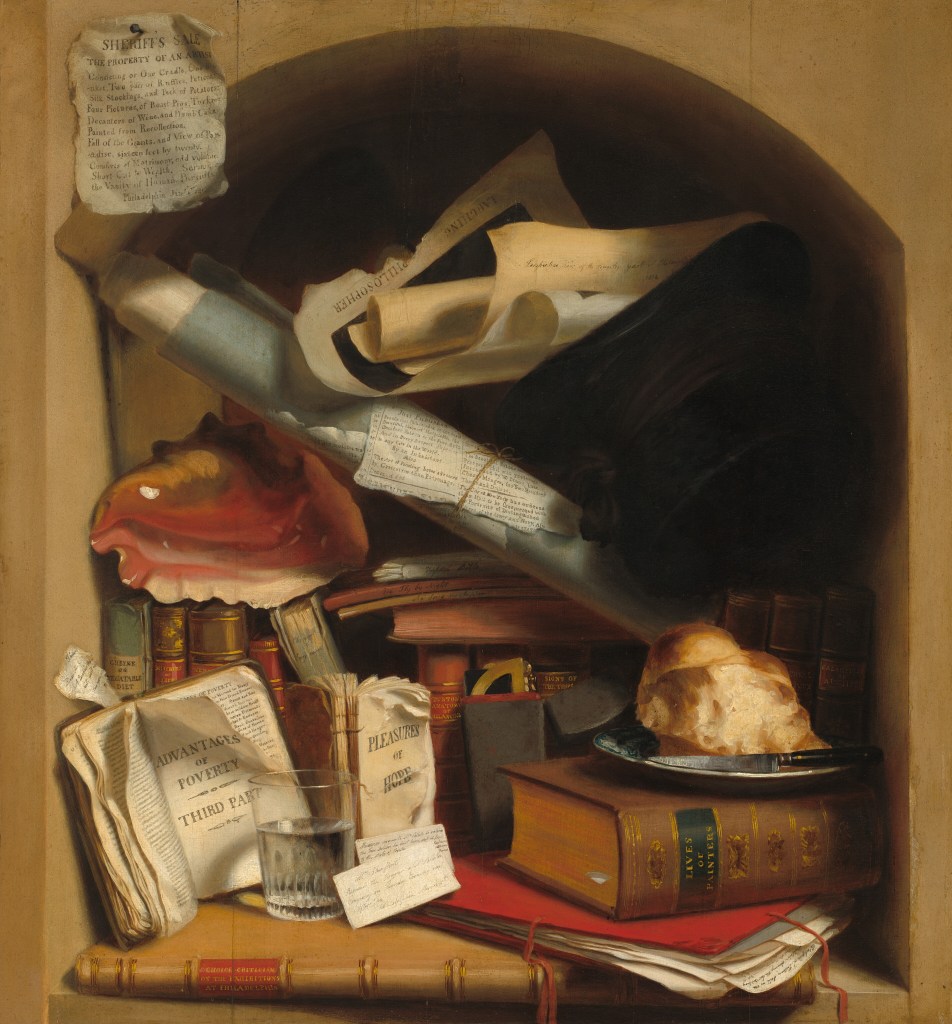
Poor Artist’s Cupboard, c. 1815
Click image to visit the National Gallery website
About the Art and the Artist.
Charles Bird King painted this unusual and intriguing trompe-l’oeil, meaning “fool-the-eye,” still life to resemble an alcove holding fictional artist C. Palette’s meager possessions: a crust of bread, glass of water, palette, and journal of unpaid bills. Two calling cards addressed to Palette bespeak his sad circumstances. One, from a parsimonious would-be patron, Mrs. Skinflint, invites him to visit her after tea, and the other records the artist’s debt of five dollars. Several details suggest a more complex message, and that Palette’s tastes and ambitions outstrip his modest means. The advertisement for a Philadelphia sheriff’s sale of an artist’s property at the upper left lists a few articles of clothing and a peck of potatoes—in stark contrast to the fashionable beaver pelt hat nearby—but also features a 16-by-20-foot painting called Pursuit of Happiness.
King makes pointed reference to the lack of support for the arts in Philadelphia, where he lived with little professional success from 1812 to 1816, and more broadly to the lack of support for the arts in America. In addition to the locale of the sheriff’s sale, a sheet of paper on top of the hat shows a perspective view of the city debtors’ jail. A tally of paintings sold in Philadelphia, which peeks out from the red portfolio at lower right, records a large number of portraits, the most popular but least creative genre of the period. A book titled Choice Criticism on the Exhibitions at Philadelphia, at the very bottom, is noticeably thin; that and Mrs. Skinflint’s invitation imply the lack of art patronage in Philadelphia. Indeed, many of King’s fellow artists departed the city due to a lack of commissions.
Journal
DOWNLOAD AND USE THE SPACE PROVIDED BELOW TO REFLECT ON THIS ARTWORK, AND ENGAGE WITH CULTURAL PROFICIENCY
 EquityThroughArt