Wilhelm Lehmbruck
Seated Youth, 1917
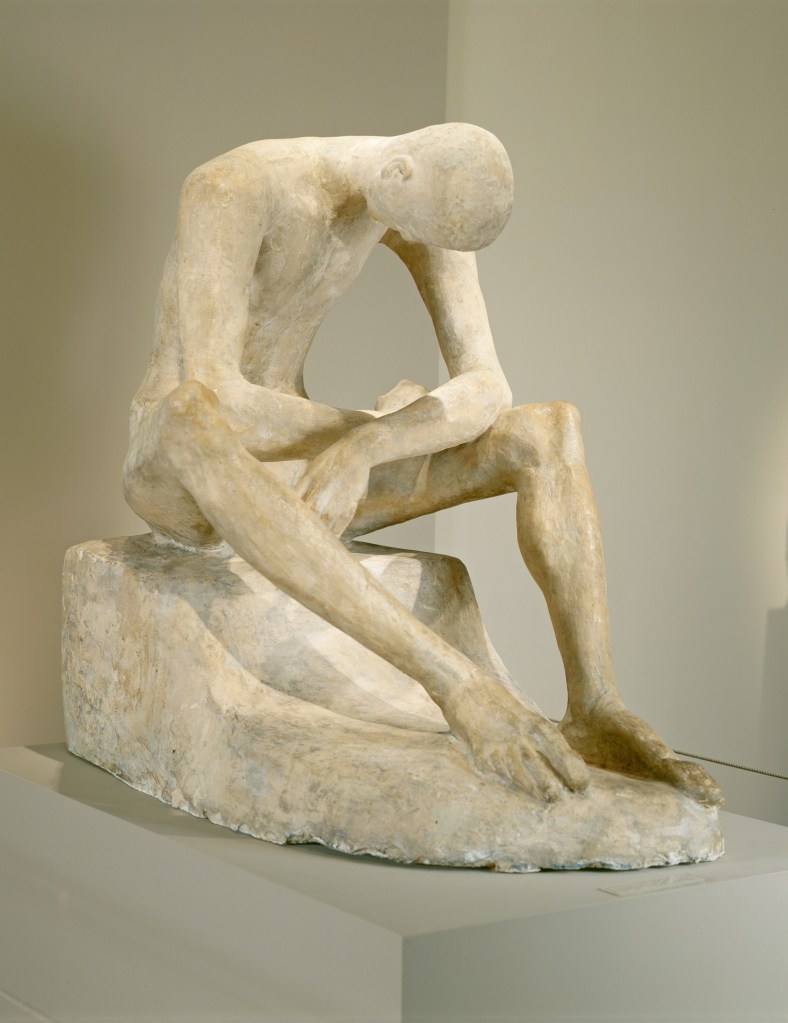
Courtesy of the National Gallery, Washington
About the Artist and the artwork
Seated Youth represents the fullest synthesis of Wilhelm Lehmbruck’s sculptural style and is arguably his greatest achievement as an artist. In the originality of its formal language and its deeply expressive content, Seated Youth would influence sculptors as diverse as Alberto Giacometti and Henry Moore. Any serious attempt to appreciate the unique formal and thematic qualities of Seated Youth, however, must begin with the context of World War I and Lehmbruck’s response to that modern conflagration.
We see a nude young man seated alone in a closed, self-contained, reflective, and melancholic pose. All nonessential elements have been eliminated, and we focus our attention solely on the expressive arrangement of the bowed head, the intertwined limbs, and the pockets of negative space that unite the form. This last aspect of the figure, its use of space, is especially powerful and reflects Lehmbruck’s awareness of contemporary Parisian trends in sculpture. Anatomy is reduced, elongated, and abstracted. The formal language both underlies and reinforces the sculpture’s expressive content. It is, in fact, the primary vehicle for conveying the grief, hopelessness, and despair that permeate the work.
Seated Youth is the visual equivalent of the rich and varied literature that emerged in the aftermath of World War I. It can be said to stand for all members of the “lost generation” referred to by the writers Gertrude Stein, Ernest Hemingway, Erich Maria Remarque, and Robert Graves and by the poets Siegfried Sassoon and Wilfred Owen.
Seated Youth, subtitled “The Friend,” portrays both survivor and mourner, one who questions his own existence while he meditates on and grieves over the loss of friends. It was Lehmbruck’s final testament as a sculptor.
JOURNAL
DOWNLOAD AND USE THE SPACE PROVIDED BELOW TO REFLECT ON THIS ARTWORK, AND ENGAGE WITH CULTURAL PROFICIENCY.
 EquityThroughArt