Albert Besnard
Sadness (Tristesse), 1887
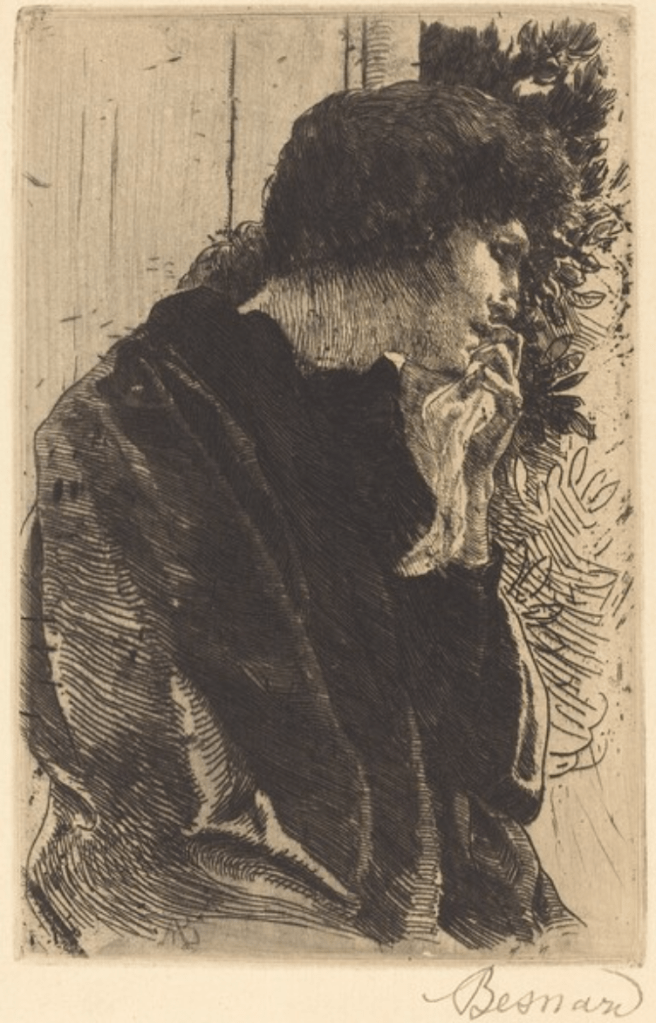
Click the image to visit the National Gallery website
Courtesy of the National Gallery, Washington
About the Art and the Artist.
Until about 1880 he followed the academic tradition, but then broke away completely, and devoted himself to the study of color and light as conceived by the Impressionists. The realism of this group never appealed to his bold imagination, but he applied their technical method to ideological and decorative works on a large scale, such as his frescoes at the Sorbonne, the Ecole de Pharmacie, the ceiling of the Comédie-Française (main theatre in Paris), the Salle des Sciences at the Hôtel de Ville, the mairie of the 1st arrondissement, and the chapel of Berck hospital, for which he painted twelve Stations of the Cross in an entirely modern spirit.
A great virtuoso, he achieved brilliant successes alike in watercolor, pastel, oil and etching, both in portraiture, in landscape and in decoration. His close analysis of light can be studied in his picture La femme qui se chauffe at the Luxembourg in Paris, one of a large group of nude studies of which a later example is Une Nymphe au bord de la mer; and in the work produced during and after a visit to India in 1911. A large panel, Peace by Arbitration, was completed seven days before the outbreak of war in 1914.
Journal
DOWNLOAD AND USE THE SPACE PROVIDED BELOW TO REFLECT ON THIS ARTWORK, AND ENGAGE WITH CULTURAL PROFICIENCY
 EquityThroughArt